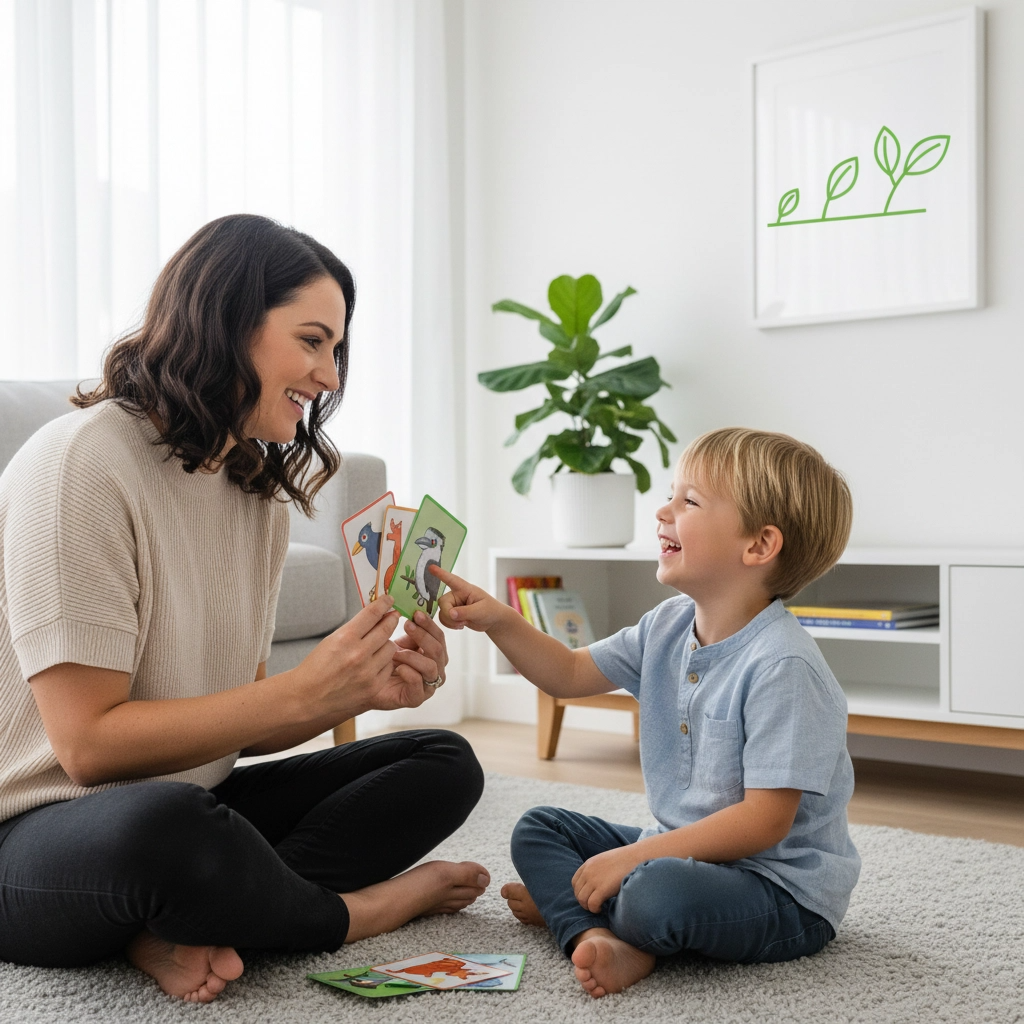
Follow Your Child's Lead
The single most powerful thing you can do is follow your child's lead during play. Watch what captures their attention, then join in. If they are stacking blocks, stack blocks alongside them. If they are pushing a toy car, push one too. When children feel genuinely heard and understood, they are far more motivated to communicate.
Rather than directing the activity or quizzing your child ("What colour is that? What does the dog say?"), try commenting on what you both see and do. "The red block fell down. Oh no!" This kind of running commentary, sometimes called self-talk and parallel talk, exposes children to rich vocabulary in context, which is exactly how language is built.
Expand What Your Child Says
When your child says something, repeat it back with just a little more. If they say "dog," you say "big dog" or "the dog is running." If they say "want juice," you say "I want more juice, please." This technique, known as expansion, gently models the next step in language development without correcting or putting pressure on your child.
The key is to keep it natural and conversational. You are not drilling them; you are simply showing them what a slightly longer version of their message sounds like.
Create Opportunities to Communicate
Children who have everything they need within easy reach have fewer reasons to communicate. Creating small, playful opportunities to request and comment can make a real difference. Put a favourite toy just out of reach and wait with an expectant look. Offer a small amount of a preferred food and pause before giving more. Start a familiar routine and then stop partway through, waiting for your child to fill in the next step.
These pauses give your child a reason to communicate and the space to do so. Resist the urge to fill the silence too quickly. A few seconds of comfortable waiting can be all it takes.
Read Together Every Day
Reading aloud is one of the richest language activities available to families. It exposes children to vocabulary they would rarely encounter in everyday conversation, builds listening skills, and creates a shared focus of attention that is ideal for language learning. Even ten minutes of shared reading each day adds up to over 60 hours a year of concentrated language input.
Choose books with repetition, rhythm, and clear illustrations. As you read, point to pictures, name what you see, and make connections to your child's own life. "Look, the puppy is hiding. Remember when our dog hid under the bed?" These connections help children understand that language is meaningful, not just a series of sounds.
Reduce Background Noise
Language learning requires listening, and listening is harder when the television is on in the background or music is playing loudly. During meals, car trips, and play time, try reducing background noise so your child can focus on the sounds and words around them. These quieter moments are often when the richest conversations happen naturally.
Practise the Targets Your Therapist Has Set
Your speech pathologist will give you specific targets to work on between sessions, whether that is a particular sound, a type of sentence structure, or a set of vocabulary words. These targets are chosen carefully based on where your child is in their development, so practising them consistently makes a significant difference to progress.
If you are unsure how to practise a target, or if your child becomes frustrated during practice, let your therapist know at the next session. It is completely normal to need guidance on how to make practice feel natural and enjoyable rather than like homework.
Be Patient and Celebrate Progress
Language development is not linear. There will be weeks when your child seems to leap forward and weeks when progress feels invisible. Both are normal. Celebrate the small wins: a new word used spontaneously, a longer sentence than last week, a sound produced correctly for the first time. These moments matter enormously, and your enthusiasm tells your child that communication is worthwhile.
If you ever have concerns about your child's progress or are unsure whether what you are seeing is typical, do not hesitate to raise it with your speech pathologist. You know your child better than anyone, and your observations are always valuable.
Supporting your child's speech development at home does not require hours of structured practice. It requires presence, responsiveness, and a willingness to follow their lead. The everyday moments, the meals, the bath times, the car trips, are full of language learning opportunities. You are already doing more than you realise.
Luna Speech Pathology provides mobile speech therapy services across Newcastle, Lake Macquarie, and the Central Coast. If you have questions about your child's speech development, we would love to hear from you.